April 7th 2025–June 9th 2025
AI News Bias Analysis: Ana
Team: Bhavika Arigala, Diego J. Reyes-Alicea, Suleyman Sarigoz, Vedant Darak
Role: Lead UI designer, qualitative/quantitative research and analysis, thematic analysis

Project Overview
Ana is an AI-powered news aggregator designed to detect media bias and support users in accessing factual, balanced news. This mobile app points out biased content and explains its origins while encouraging media literacy through embedded educational content.
Key Insights
73%
Reported Ana helped them view news more critically
80%
Considered receiving the full story as essential
Methods
Our first step was conducted user interviews to learn users’ skepticism toward AI and the news. The interviews concluded with a card sorting activity that required users to order Ana’s media analysis output. Ana’s output was then tested in our in-class activity, to understand how users’ perceive Ana.
Literature Review
AI instructions
Survey
Interview/card sorting
The UI design of Ana was was critiqued through request-for-proposal exchange with another capstone project team. We then tested the high-fidelity version of Ana using the Rapid Iterative Testing and Evaluation (RITE) method.
Flowchart
Lo-Fi design
RFP Trade
Mid-fi design
RITE testing
AI News Bias Analysis
Timeline: April 7th 2025–June 9th 2025
Team: Bhavika Arigala, Diego J. Reyes-Alicea, Suleyman Sarigoz, Vedant Darak
Role: Lead UI designer, qualitative/quantitative research and analysis, thematic analysis
Ana’s AI Sytem
Check out framer
resources for something cool
To validate both our AI's output and our hypothesis about the user-AI perception gap, we conducted a "Media Bias Detection Sprint" in class. Following a structured protocol, classmates first analyzed headlines manually and then compared their findings to Ana's generated analysis.


1.1 Media Analyze

1.2.a Main Takeaways

1.2.b Main Takeaways

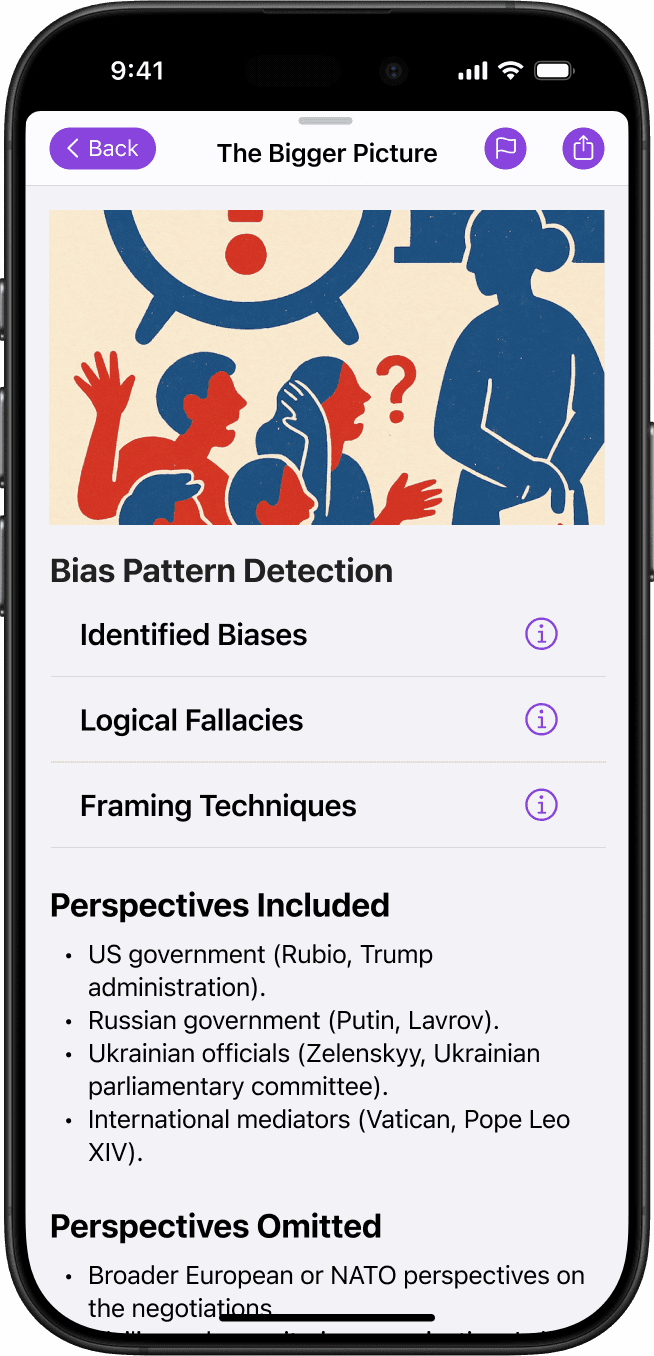
1.3 The Bigger Picture
1.4 About the Source

1.5 Share with Comments

MVP: Single Media Analysis
The primary function is to provide a clear analysis of media inputted into Ana. The output gives details on source credibility, detected biases, perspectives included/omitted and other information to consider. This function was the focus of user testing.
Completed Flows
These flows are complete and users had a chance to view their current progression. For brevity, only 3 screens for each flow. Scroll left in the gray area to view screens.
Flow 1 of 4
News For You
Users can view news by topics selected in their account. Additional features include viewing various topics from different political perspectives.
2.1.a News For You, Center

2.1.b News For You, Left
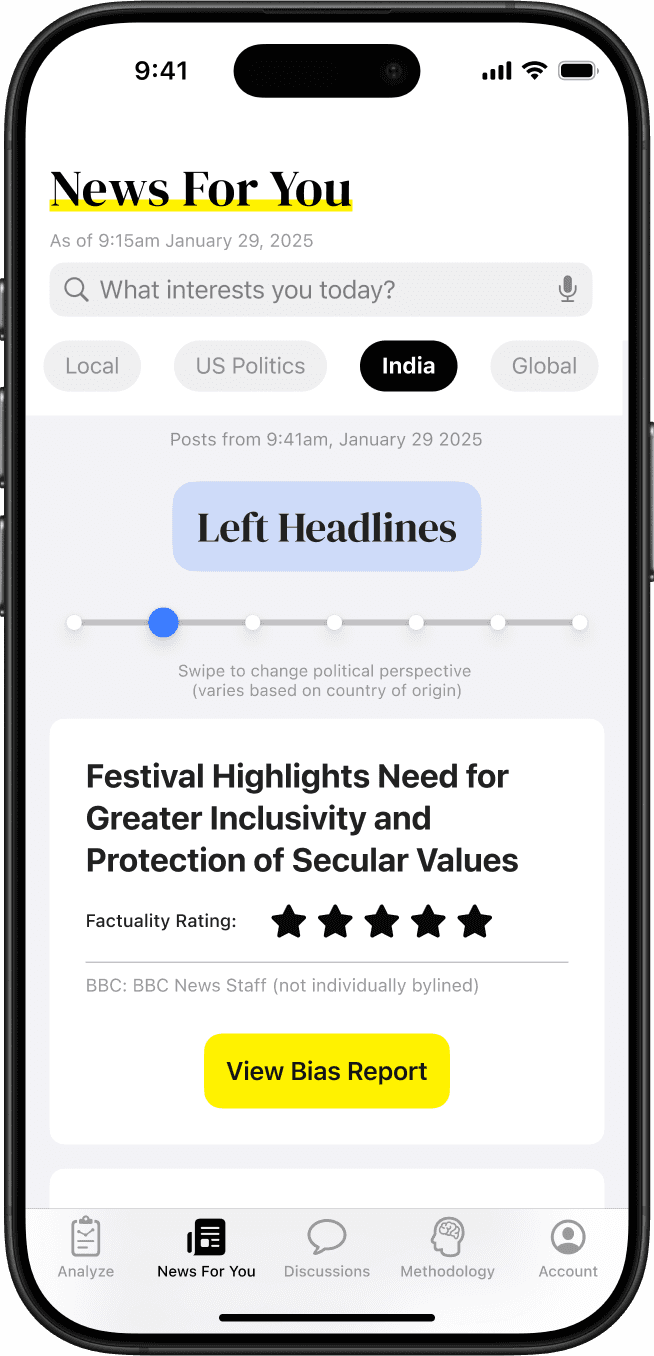
2.1.b News For You, Right

Flow 2 of 4
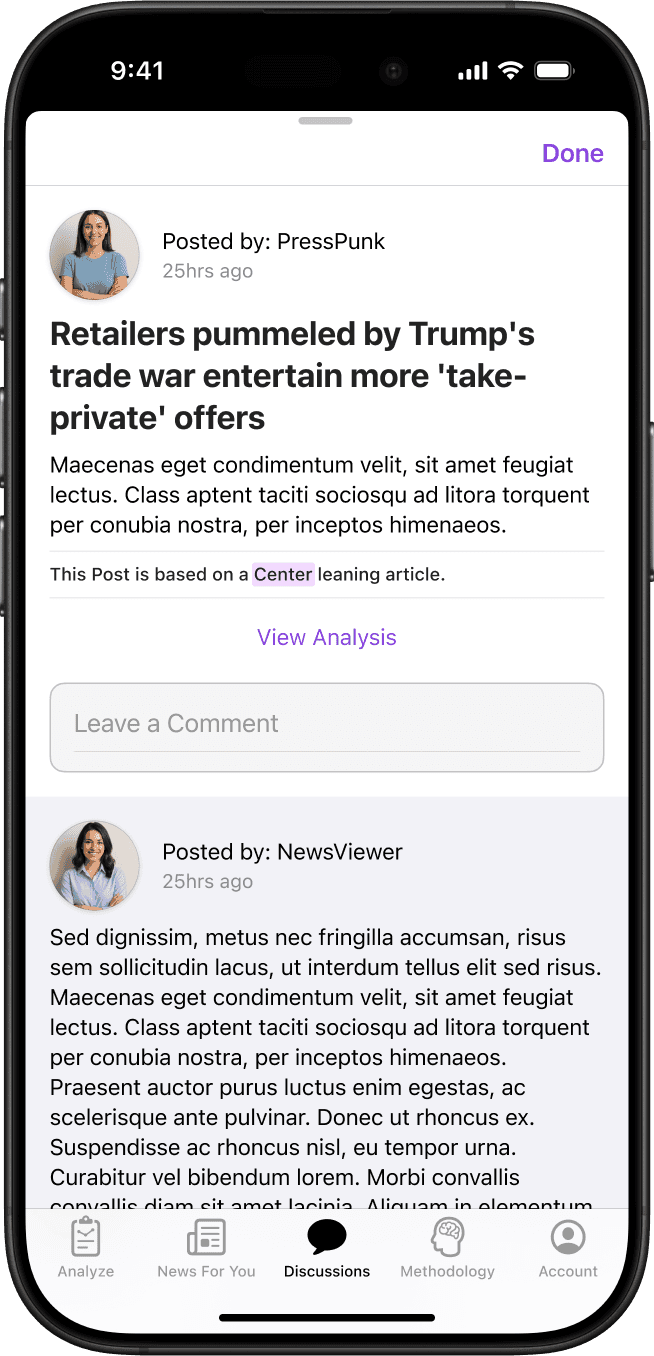
Discussions
Account holders with Ana can interact with other users with an online alias. This is a space for users to share media analysis and engage in conversation.
3.0.a Discussions
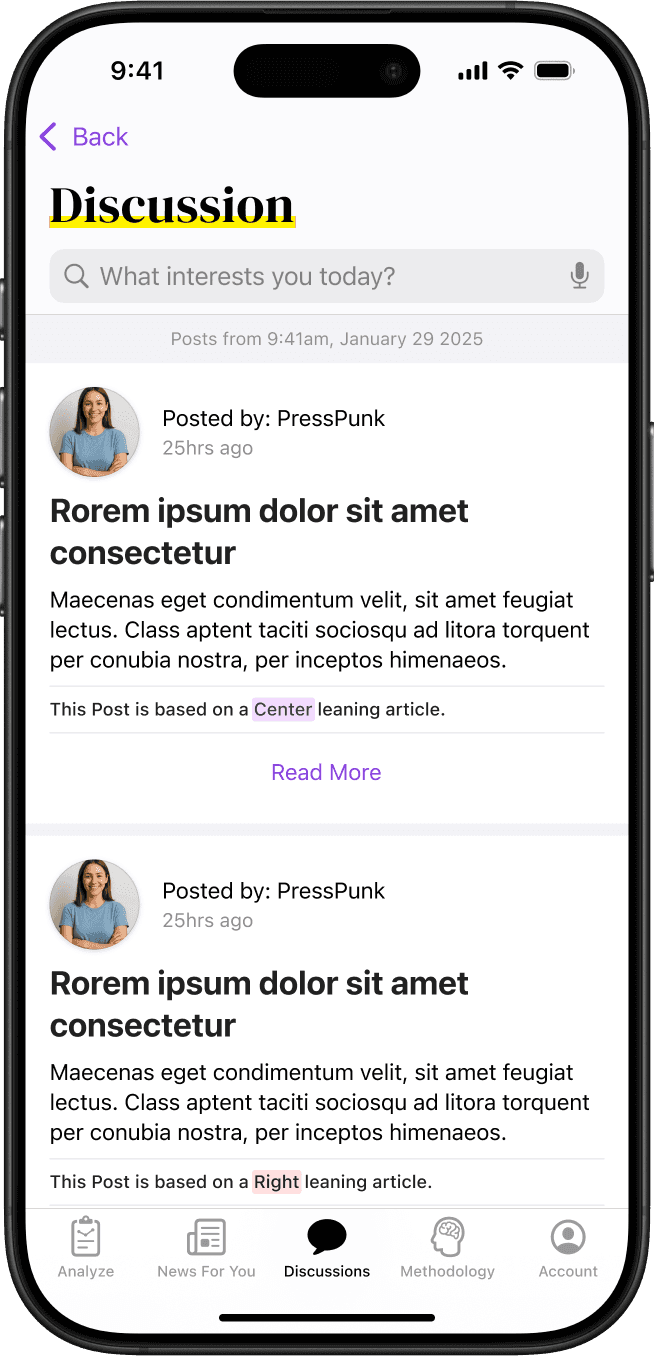
3.0.b Discussions Search
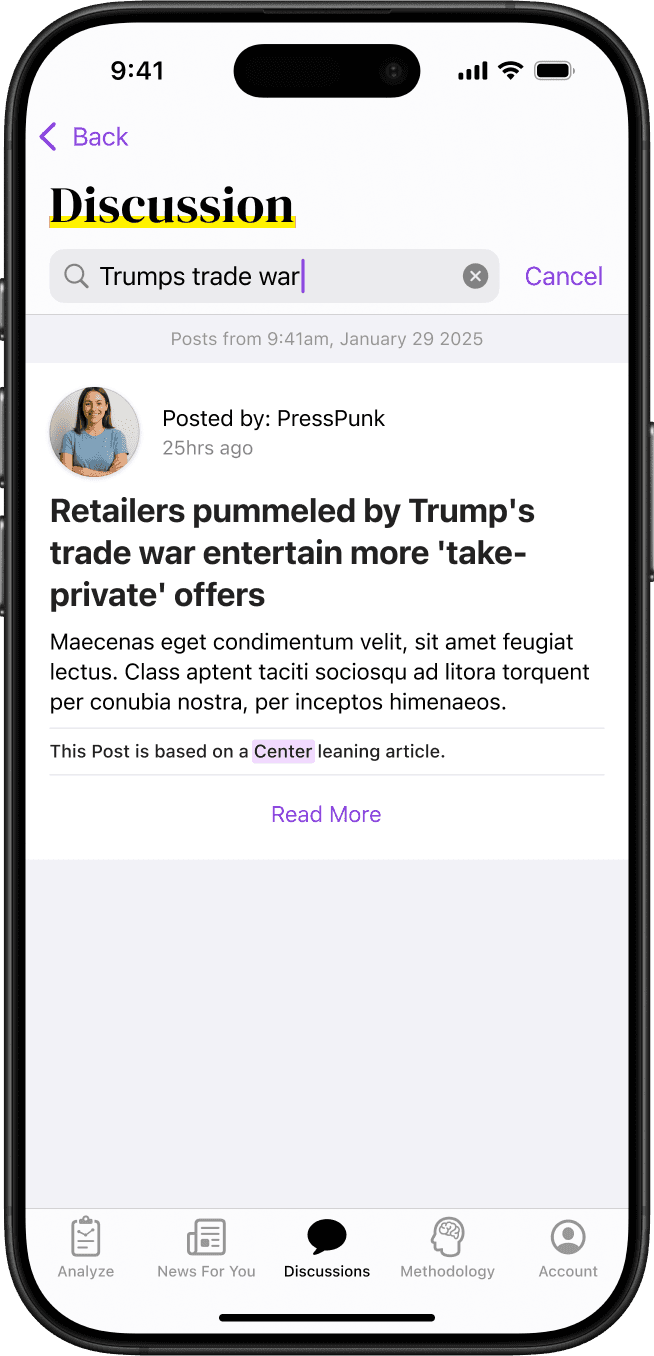
3.2 Discussions Posting
Flow 3 of 4
Methodology
This section acts as a database for how Ana works as well as keywords used in the space of media bias. We want to provide clarity to ease AI skepticism.
4.0 Methodology

4.1 Source Credibility

4.6 Keywords

Flow 4 of 4
Account
Users are encouraged to create an account to: view previous analyzed articles, partake in discussion, and select topics for their “News For You” page.
5.0 Account Creation

5.7 Topic Selection

5.7 Ana Explanation

Survey Findings
Overt Bias
Participants accurately identified headlines with overt, emotionally charged language with 51.3% accuracy.
Subtle Framing
46.2% of respondents misidentified a right-center headline ("Trump needs unity...") as "Least Biased," suggesting users often miss bias embedded in seemingly neutral language.
Subject vs Perspective
66.7% of participants perceived a left-leaning headline critical of the GOP as right-leaning, confusing the article's subject (conservatives) with its critical perspective (left-leaning).
Market Potential
82% of respondents never having used AI news aggregator indicates our product has significant market education potential.
Interview Findings
The interviews explored political views, perceptions of bias, and news consumption habits. Participants expressed deep skepticism toward mainstream and AI-generated news, citing fears of misinformation and algorithmic manipulation. Our interviews revealed a strong preference for tools that could identify bias, facilitate fact-checking, and present multiple perspectives.
Columns in blue represent the political perspective of the participant (based on U.S. politics).

User Quote: P2
Skepticism in AI
“I thought about ChatGPT, like getting the article there and saying, okay, is this true or not? But also... you can’t trust [AI] 100%"
User Quote: P9
Opposing Political Sides
“Messy defiance is is much better than getting along with everyone.“
Card Sorting Activity
User interviews participated in a card sorting at the end of their interview. This activity gave us an initial idea of the order of in which Ana’s output should be presented.
Core Evaluation
Source Credibility
Factual Reporting Assessment
Alternative Framing
Contextual Analysis
Political Bias Analysis
Bias Pattern Detection
Balance Check
Headline Sources
Explore More
Recommendations
Related Topics
Contextual Analysis
Political Bias Analysis
Bias Pattern Detection
Balance Check
Headline Sources
Explore More
Recommendations
Related Topics
Card Sorting Activity
User interviews participated in a card sorting at the end of their interview. This activity gave us an initial idea of the order of in which Ana’s output should be presented.
Core Evaluation
Source Credibility
Factual Reporting Assessment
Alternative Framing
Created Ana Pages
MVP Flow: Single Media Analysis
News For You
Methodology
Discussions
Account

Lo-Fi to Mid-Fi
Our team traded Requests for Proposal with Her Team (another capstone project team). My team and I found themselves debating over micro design decisions that could easily be solved using a component library. We selected the IOS 18 component library because of its popularity amongst mobile users.
Her Team confirmed that the core concept was strong and the onboarding flow was "smooth and intuitive".
MVP: Single Media Analysis
The primary function is to provide a clear analysis of media inputted into Ana. The output gives details on source credibility, detected biases, perspectives included/omitted and other information to consider. This function was the focus of user testing.
1.1 Media Analyze
1.2.a Main Takeaways
1.2.b Main Takeaways
1.3 The Bigger Picture
1.4 About the Source
1.5 Share with Comments
Completed Flows
These flows are complete and users had a chance to view their current progression. For brevity, only 3 screens for each flow. Scroll left in the gray area to view screens.
Flow 1 of 4
News For You
Users can view news by topics selected in their account. Additional features include viewing various topics from different political perspectives.
2.1.a News For You, Center
2.1.b News For You, Left
2.1.b News For You, Right
Flow 2 of 4
Discussions
Account holders with Ana can interact with other users with an online alias. This is a space for users to share media analysis and engage in conversation.
3.0.a Discussions
3.0.b Discussions Search
3.2 Discussions Posting
Flow 3 of 4
Methodology
This section acts as a database for how Ana works as well as keywords used in the space of media bias. We want to provide clarity to ease AI skepticism.
4.0 Methodology
4.1 Source Credibility
4.6 Keywords
Flow 4 of 4
Account
Users are encouraged to create an account to: view previous analyzed articles, partake in discussion, and select topics for their “News For You” page.
5.0 Account Creation
5.7 Topic Selection
5.7 Ana Explanation
User Testing
Ana’s current MVP comes from a round of usability testing using the RITE method. The testing was conducted within a week. The usability test focused on the single media analysis flow. Participants were then encouraged to explore the rest of the application.
Participant 1
36, Male, Unemployed
Participant 2
26, Male, Student

Testing Highlights
Information Hierarchy
Users requested to see the “Main Take aways” immediately, but the initial design buried this content below the scroll.
Interaction Clarity
Key interactive elements, like the “main Takeaways” button, lacked strong visual cues to show they were clickable.
Content Orginization
Based on the RFP and user testing, we reorganized the order of analyzed article information including the names of each section.

Reflection & Future Work
Ana’s current MVP comes from a round of usability testing using the RITE method. The testing was conducted within a week. The usability test focused on the single media analysis flow. Participants were then encouraged to explore the rest of the application.
Building Interactivity
Implement user-requested flagging and feedback mechanisms to create a “human-in-the-loop” system that refines AI analysis over time, building trust and engagement.
Enhancing AI Explainability
Develop the AI to provide nuanced explanations for its bias ratings, particularly for complex cases like the subject/perspective confusion we observed.
Broader Demographic Testing
Conduct studies with a more politically and demographically diverse user base to ensure Ana is effective for all users.
Expanding to Desktop
Ana was designed to be successful as a responsive design, next steps include designing the desktop version.
Other
Projects
Exploring How to Support Creative Block
Usability Test Report: DeKalb County Website
Interested in collaborating? Let’s connect!
copyright Diego J. Reyes-Alicea | designed by Diego J. Reyes-Alicea | updated July 2025
Interested in collaborating? Let’s connect!
copyright Diego J. Reyes-Alicea | designed by Diego J. Reyes-Alicea
updated July 2025
Diego J. Reyes-Alicea
AI News Bias Analysis
Timeline: April 7th 2025–June 9th 2025
Team: Bhavika Arigala, Diego J. Reyes-Alicea, Suleyman Sarigoz, Vedant Darak
Role: Lead UI designer, qualitative/quantitative research and analysis, thematic analysis
Project Overview
Ana is an AI-powered news aggregator designed to detect media bias and support users in accessing factual, balanced news. This mobile app points out biased content and explains its origins while encouraging media literacy through embedded educational content.
Method
The UI design of Ana was was critiqued through request-for-proposal exchange with another capstone project team. We then tested the high-fidelity version of Ana using the Rapid Iterative Testing and Evaluation (RITE) method.
We then conducted user interviews to learn users’ skepticism toward AI and the news. The interviews concluded with a card sorting activity that required users to order Ana’s media analysis output. Ana’s output was then tested in our in-class activity, to understand how users’ perceive Ana.
Ana’s AI instructions were informed by literature reviews, which provided resources for how AI can highlight bias information. We also launched a survey focused on how users perceive bias.
AI instructions
Literature review
Survey
Interview/card sorting
Research Phase
Design Phase
Flowchart
Lo-Fi design
RFP Trade
Mid-fi design
RITE testing
Key Insights
82%
Of participants have never used an AI news aggregator
80%
Considered receiving the full story as essential
73%
Reported Ana helped them view news more critically
Interview Findings
The interviews explored political views, perceptions of bias, and news consumption habits. Participants expressed deep skepticism toward mainstream and AI-generated news, citing fears of misinformation and algorithmic manipulation. Many called for greater transparency and diverse viewpoints. Our interviews revealed a strong preference for tools that could identify bias, facilitate fact-checking, and present multiple perspectives.
Columns in blue represent the political perspective of the participant (based on U.S. politics).
User Quote: P3
Recognizing News Outlets
“I’m reading an article and there’s, like, one side of the story, I will question or not, because good news articles show both side and let the reader choose for themselves."
User Quote: P2
Skepticism in AI
“I thought about ChatGPT, like getting the article there and saying, okay, is this true or not? But also... you can’t trust [AI] 100%"
User Quote: P6
Low Trust in News
“You end up in a place where you have to compare the news on both sides... and you start seeing how on both sides, the news lies"
User Quote: P9
Opposing Political Sides
“Messy defiance is is much better than getting along with everyone.“
Contextual Analysis
Political Bias Analysis
Bias Pattern Detection
Balance Check
Headline Sources
Explore More
Recommendations
Related Topics
Core Evaluation
Source Credibility
Factual Reporting Assessment
Alternative Framing
Card Sorting Activity
User interviews participated in a card sorting at the end of their interview. This activity gave us an initial idea of the order of in which Ana’s output should be presented.
Ana’s AI Sytem
We prompt engineered a set of custom instructions for the underlying large language model, using Perplexity. This methodology was inspired by scholarly work on quantifying bias, notably from Xiao Fang et al.'s article, "Bias of AI-generated content."
To validate both our AI's output and our hypothesis about the user-AI perception gap, we conducted a "Media Bias Detection Sprint" in class. Following a structured protocol, classmates first analyzed headlines manually and then compared their findings to Ana's generated analysis.
Try Ana
Planning to Wire framing
In order to define what we wanted in the MVP of Ana. We created a user flow chart of various tasks and the functionality of potential pages. Some of the post important flows that were identified included:

MVP Flow: Single Media Analysis
News For You
Methodology
Discussions
Account
Lo-Fi to Mid-Fi
Our team traded Requests for Proposal with Her Team (another capstone project team). My team and I found themselves debating over micro design decisions that could easily be solved using a component library. We selected the IOS 18 component library because of its popularity amongst mobile users.
MVP: Single Media Analysis
The primary function is to provide a clear analysis of media inputted into Ana. The output gives details on source credibility, detected biases, perspectives included/omitted and other information to consider. This function was the focus of user testing.
1.1 Media Analyze
1.2.a Main Takeaways
1.2.b Main Takeaways
1.3 The Bigger Picture
1.4 About the Source
1.5 Share with Comments
Completed Flows
These flows are complete and users had a chance to view their current progression. For brevity, only 3 screens for each flow. Scroll left in the gray area to view screens.
Flow 1 of 4
News For You
Users can view news by topics selected in their account. Additional features include viewing various topics from different political perspectives.
2.1.a News For You, Center
2.1.b News For You, Left
2.1.b News For You, Right
Flow 2 of 4
Discussions
Account holders with Ana can interact with other users with an online alias. This is a space for users to share media analysis and engage in conversation.
3.0.a Discussions
3.0.b Discussions Search
3.2 Discussions Posting
Flow 3 of 4
Methodology
This section acts as a database for how Ana works as well as keywords used in the space of media bias. We want to provide clarity to ease AI skepticism.
4.0 Methodology
4.1 Source Credibility
4.6 Keywords
Flow 4 of 4
Account
Users are encouraged to create an account to: view previous analyzed articles, partake in discussion, and select topics for their “News For You” page.
5.0 Account Creation
5.7 Topic Selection
5.7 Ana Explanation
Building Interactivity
Implement user-requested flagging and feedback mechanisms to create a “human-in-the-loop” system that refines AI analysis over time, building trust and engagement.
Enhancing AI Explainability
Develop the AI to provide nuanced explanations for its bias ratings, particularly for complex cases like the subject/perspective confusion we observed.
Broader Demographic Testing
Conduct studies with a more politically and demographically diverse user base to ensure Ana is effective for all users.
Expanding to Desktop
Ana was designed to be successful as a responsive design, next steps include designing the desktop version.
Reflection & Future Work
Ana’s current MVP comes from a round of usability testing using the RITE method. The testing was conducted within a week. The usability test focused on the single media analysis flow. Participants were then encouraged to explore the rest of the application.
User Testing
Ana’s current MVP comes from a round of usability testing using the RITE method. The testing was conducted within a week. The usability test focused on the single media analysis flow. Participants were then encouraged to explore the rest of the application.
Participant 1
36, Male, Unemployed
Participant 2
26, Male, Student
Testing Highlights
Information Hierarchy
Users requested to see the “Main Take aways” immediately, but the initial design buried this content below the scroll.
Interaction Clarity
Key interactive elements, like the “main Takeaways” button, lacked strong visual cues to show they were clickable.
Content Orginization
Based on the RFP and user testing, we reorganized the order of analyzed article information including the names of each section.
Interested in collaborating? Let’s connect!
copyright Diego J. Reyes-Alicea
designed by Diego J. Reyes-Alicea
updated July 2025
Survey Findings
Overt Bias
Participants accurately identified headlines with overt, emotionally charged language with 51.3% accuracy.
Subtle Framing
46.2% of respondents misidentified a right-center headline ("Trump needs unity...") as "Least Biased," suggesting users often miss bias embedded in seemingly neutral language.
Subject vs Perspective
66.7% of participants perceived a left-leaning headline critical of the GOP as right-leaning, confusing the article's subject (conservatives) with its critical perspective (left-leaning).
Market Potential
82% of respondents never having used AI news aggregator indicates our product has significant market education potential.